← Emirhan Aksu

Publications & Research Archive

Peer-reviewed papers in Human-Computer Interaction (HCI), AI-Assisted UX/UI, and Adaptive Interfaces.

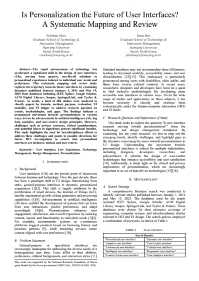
Is Personalization the Future of User Interfaces? A Systematic Mapping and Review Read Paper →

Is Personalization the Future of User Interfaces? A Systematic Mapping and Review

CHIuXiD 2025 (2025 Dec.) • DOI: 10.1109/CHIuXiD68326.2025.11323802

The rapid advancement of technology has accelerated a significant shift in the design of user interfaces (UIs), moving from generic, one-fits-all solutions to personalized experiences tailored to individual user needs and preferences. This systematic mapping and review study explores the trajectory towards future interfaces by examining literature published between January 1, 2014 and May 15, 2025 from databases including IEEE Xplore, Google Scholar, ACM Digital Library, Scopus, SpringerLink, and Taylor & Francis. As result, a total of 384 studies were analyzed to classify papers by domain, method, purpose, evaluation, UI modality, and UI trigger to address research question on trends, methodologies, and gaps. The findings indicate a pronounced movement towards personalization in various ways, driven by advancements in artificial intelligence (AI), big data analytics, and user-centric design principles. However, challenges such as privacy concerns, ethical considerations, and potential biases in algorithms present significant hurdles. This study highlights the need for interdisciplinary efforts to address these challenges and points to possible directions for future HCI investigations to ensure that personalized interfaces are inclusive, ethical, and user centric.
From Interaction to Integration: How Emerging Technologies are Transforming Human-Computer Relationships Read Paper →

From Interaction to Integration: How Emerging Technologies are Transforming Human-Computer Relationships

HCI-E 2024 (2024 Nov.) • DOI: 10.13140/RG.2.2.39187.5090

The advent of emerging technologies such as Zero User Interface (Zero UI), Personalization, Conversational Artificial Intelligence (AI), and Brain-Computer Interfaces (BCIs) is reshaping the field of human-computer interaction (HCI), moving toward a paradigm of human-computer integration. By minimizing reliance on traditional interfaces, tailoring experiences to individual users, enabling natural language communication, and introducing direct neural interaction, these technologies make interactions more intuitive and seamlessly integrated into everyday activities. This conceptual review examines how these technologies collectively drive this transformation by exploring their distinct roles and implications for users and society. It addresses challenges and ethical considerations and proposes future research directions in HCI.

From Discovery to Framework: An Exploratory Approach to AI-Assisted UX/UI Analysis Read Paper →

From Discovery to Framework: An Exploratory Approach to AI-Assisted UX/UI Analysis

HCI Korea Journal (2024 Sep.) • DOI: 10.13140/RG.2.2.38488.9784

Traditional User Experience and User Interface (UX/UI) evaluations struggle to adapt in fast-evolving digital environments due to reliance on static analysis criteria, and results can vary significantly based on differences in experts’ experience and specialization. This study introduces an AI-assisted exploratory UX/UI assessment framework designed to overcome these limitations by leveraging AI's analytical capabilities. By initiating an open dialogue with AI, the framework adopts an exploratory approach without predefined criteria, allowing for the organic development of tailored analysis prompts. These prompts dynamically adapt based on real-time AI feedback, ensuring that the evaluations remain relevant and within the operational constraints of AI technology. Early implementations suggest that this approach enhances the adaptability and depth of evaluations compared to conventional methods. The framework incrementally refines evaluation criteria to effectively address specific UX/UI challenges. It holds potential for both academic and industrial applications, offering a method that integrates theoretical insights with practical outcomes, promising to enrich UX/UI research and practice.

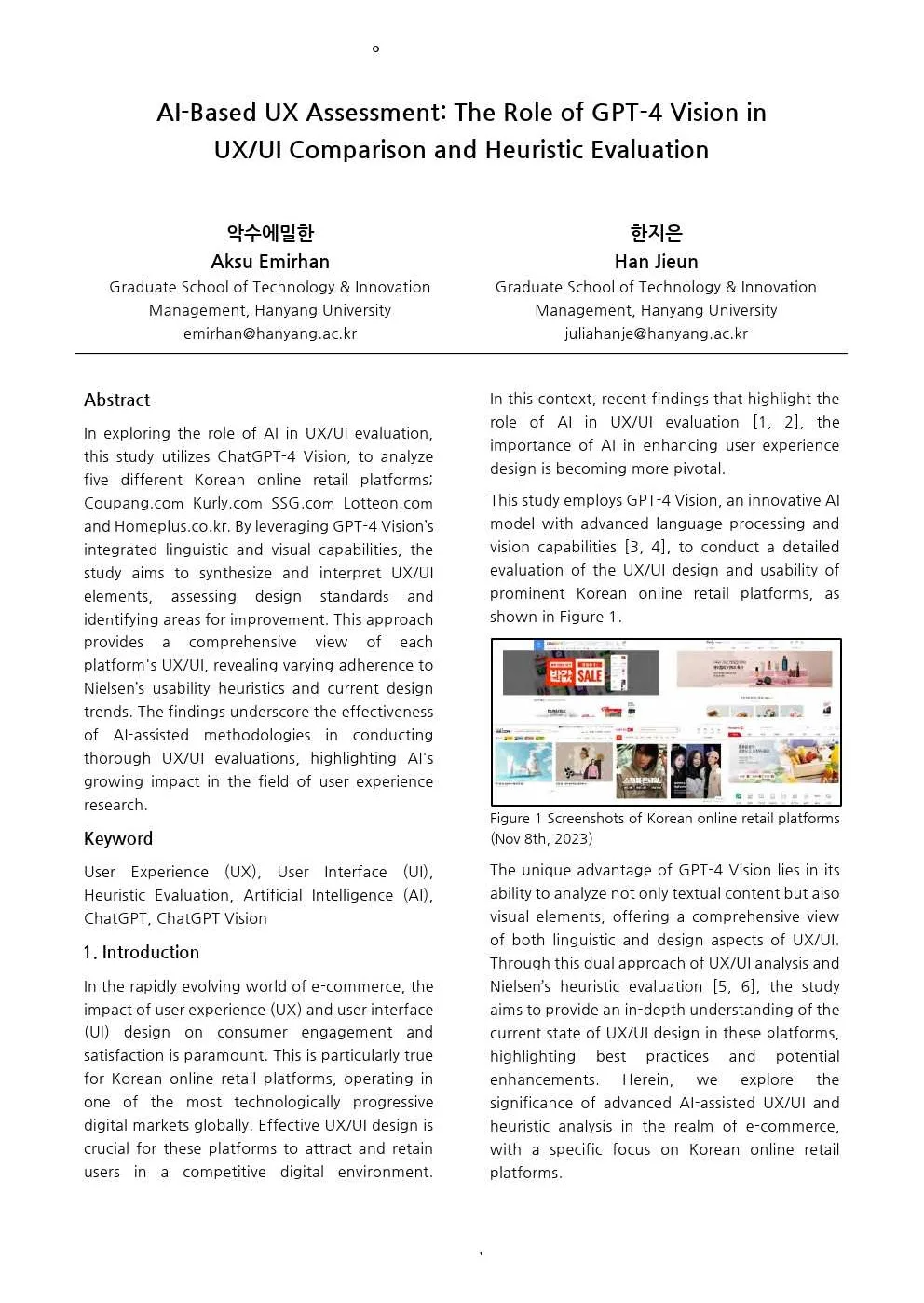
AI-Based UX Assessment: The Role of GPT-4 Vision in UX/UI Comparison and Heuristic Evaluation Read Paper →

AI-Based UX Assessment: The Role of GPT-4 Vision in UX/UI Comparison and Heuristic Evaluation

HCI Korea 2024 (2024 Jan.) • DOI: 10.13140/RG.2.2.39187.6449

In exploring the role of AI in UX/UI evaluation, this study utilizes ChatGPT-4 Vision to analyze five different Korean online retail platforms. By leveraging GPT-4 Vision's integrated linguistic and visual capabilities, the study aims to synthesize and interpret UX/UI elements, assessing design standards and identifying areas for improvement. This approach provides a comprehensive view of each platform's UX/UI, revealing varying adherence to Nielsen's usability heuristics and current design trends. The findings underscore the effectiveness of AI-assisted methodologies in conducting thorough UX/UI evaluations, highlighting AI's growing impact in the field of user experience research.

Exploring Technological Device Research Papers in Digital Libraries: A Comparative Analysis Read Paper →

Exploring Technological Device Research Papers in Digital Libraries: A Comparative Analysis

Hanyang University (2023 May.) • DOI: 10.13140/RG.2.2.38165.4980

Technological devices are ubiquitous in our modern society across communication, entertainment, education, healthcare, security, and transportation/logistics. In recent years, there has been a substantial increase in research papers focusing on technological devices and their applications, benefits, challenges, and impacts. However, finding papers based on their specific subject features or main focus of technology has become a challenging task in digital libraries and databases. Although keywords and index terms are commonly used in current Information Retrieval (IR) systems, they are inadequate for accurately differentiating and finding papers based on their conceptual focus. Researchers commonly use keywords or possible words that may be contained in the title or abstract, which can lead to irrelevant search results or missed contributions. This capstone project analyzes the retrieval precision of free text, keywords, and advanced search methods across three major digital libraries by providing comparative analysis and documentation, examining existing solutions, evaluating their effectiveness, and discussing solution methodologies for more efficient discovery.

The design of gamifying user interface for augmented reality Read Paper →

The design of gamifying user interface for augmented reality

Ondokuz Mayis University (2019 Jul.) • DOI: 10.13140/RG.2.2.37583.3551

Augmented reality is one of the prominent interactive technologies today, applied primarily across education, healthcare, advertising, tourism, engineering, and diverse industry domains. The user interface enabling interaction between the user and spatial applications is critical for providing an efficient and purposeful experience. It is aimed to provide a functional and engaging experience by guiding the user in a correct and motivating way as a result of interactions between surfaces and objects in the environment, combined with the limitations and enhancements of visual display devices. Developers and designers strive to create user-centered interfaces with gamifying elements by utilizing knowledge in psychology and design. However, standardized techniques for recognizable and accepted augmented reality interaction design have not yet reached universal conventions. This study investigates existing technologies and interfaces to formulate a user-centered, motivating, and efficient interface design framework for augmented reality applications across current and future devices, establishing new gamifying techniques to advance spatial design processes.

Digital characters' interactions with people and their roles in society Read Paper →

Digital characters' interactions with people and their roles in society

Ondokuz Mayis University (2017 Nov.) • DOI: 10.13140/RG.2.2.38165.5248

This study comprehensively analyzes and evaluates the development and evolution of digital characters across various New Media fields, including Digital Animation, Gaming, Digital Illustration, the Internet, and Programming. The research explores the interactions between digital characters and human audiences, examining the impressions and cognitive perceptions formed as a result of these interactions and the evolving roles these virtual characters play in contemporary society. By evaluating representative examples across distinct New Media areas, each with unique socio-cultural values and functional roles, this research provides a comprehensive overview and foundational insights into digital character design, virtual persona perception, and audience interaction.